

Effective Enforcement and Collective Action Key to Keeping Singapore Corruption Free
EFFECTIVE ENFORCEMENT AND COLLECTIVE ACTION KEY TO KEEPING SINGAPORE CORRUPTION-FREE
Corruption Situation in Singapore Remains Firmly Under Control
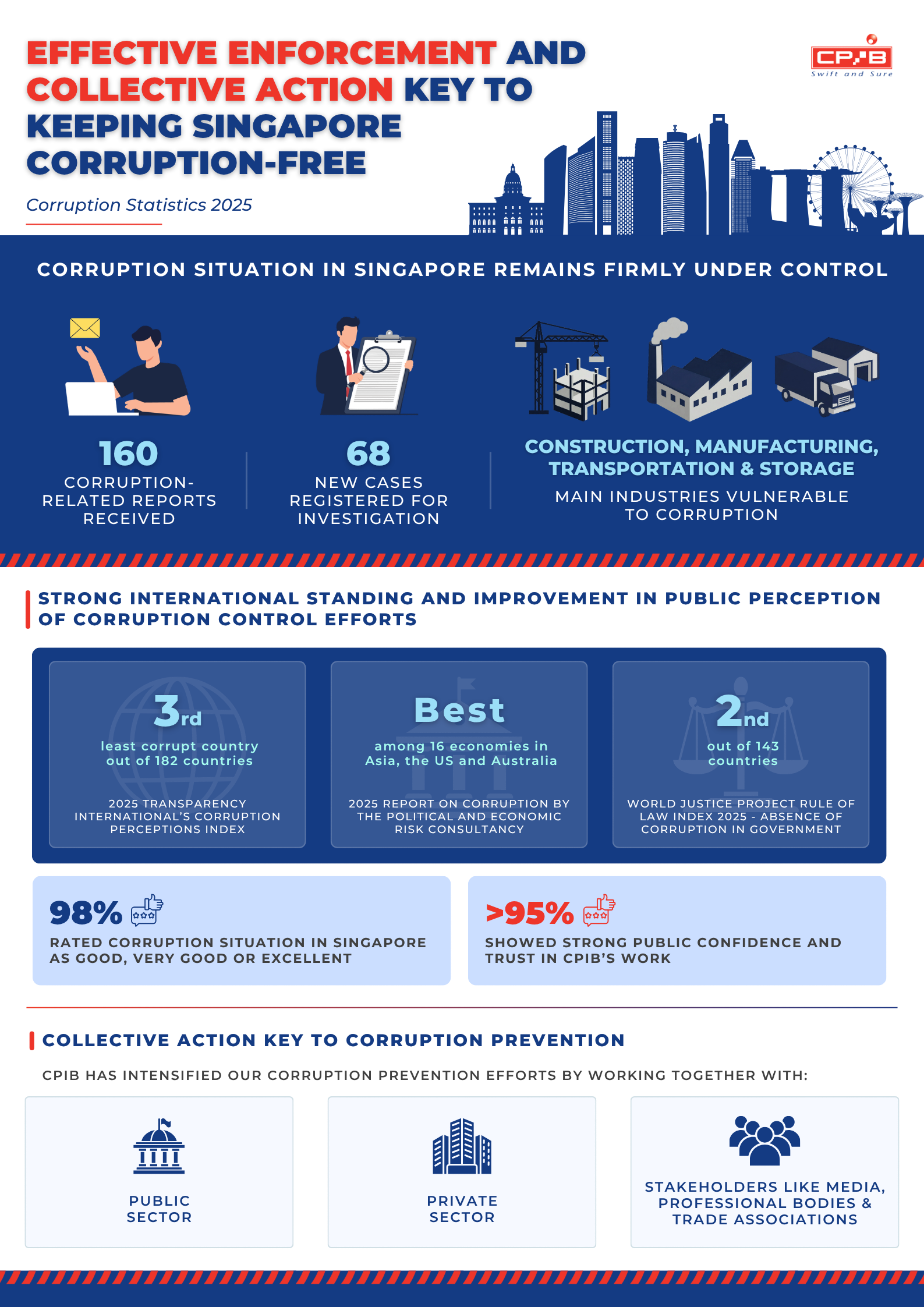
The corruption situation in Singapore remains firmly under control. The number of corruption-related reports received by CPIB, as well as the number of cases registered for investigation remained low. In 2025, CPIB received 160 corruption-related reports, a 10% decrease from the 177 corruption-related reports received in 2024. In 2025, CPIB registered 68 reports as new cases for investigation (Figure 1). A report is registered for investigation if the information received is pursuable. This is determined by the quality of relevant information provided. Investigative enquiries and intelligence probes by CPIB also uncovered further information that enabled a higher percentage of reports to be registered for investigation.
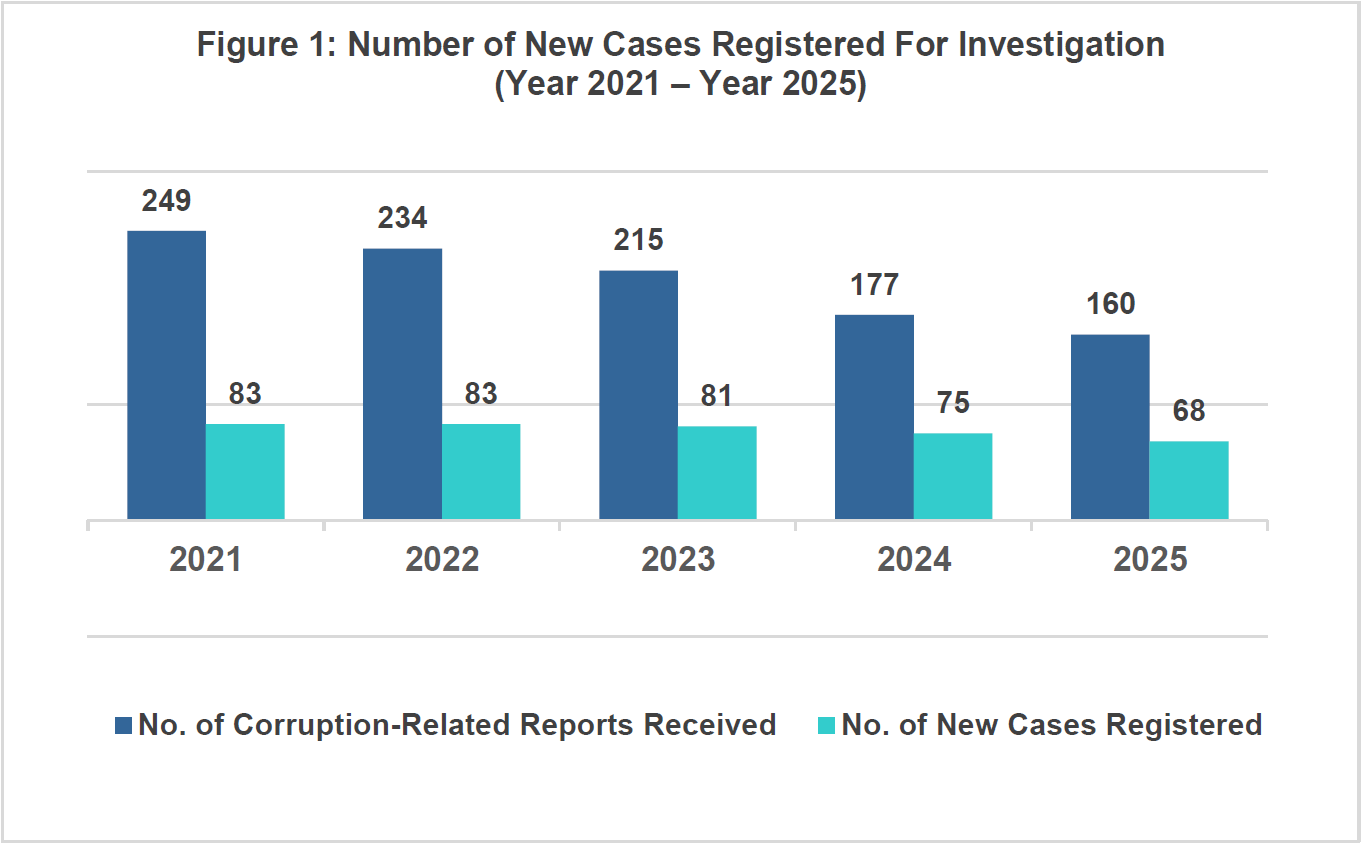
2. CPIB treats all reports received seriously regardless of whether the complainant is named or anonymous. Of the 160 corruption-related reports received in 2025, 56 (35%) were anonymous. Of the 68 cases registered for investigation in 2025, 16 (24%) were anonymous.
Number of Bribe Rejection Cases
3. Of the 68 cases registered for investigation in 2025, one involved the public sector (Figure 2). 22 cases (32%) involved public sector employees1 rejecting bribes offered by members of public.
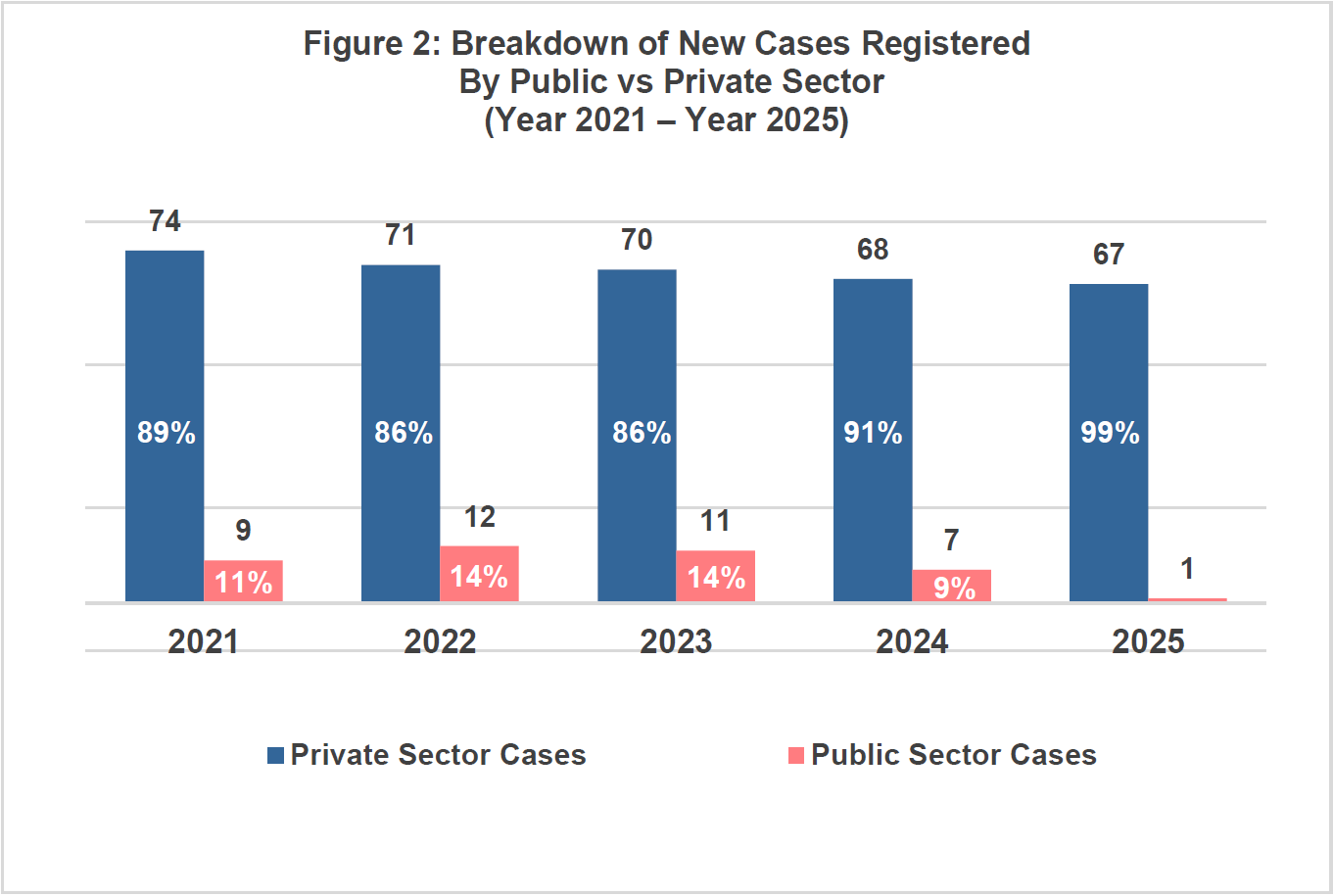
4. In 2025, 90 individuals were prosecuted in Court for offences investigated by CPIB. Of these, 84 (94%) were private sector individuals while the remaining 6 (6%) were public sector employees2. Based on the cases of private sector employees prosecuted in Court for corruption-related offences over the past 10 years, construction, manufacturing, transportation and storage were the main industries vulnerable to corruption.
High Clearance Rate
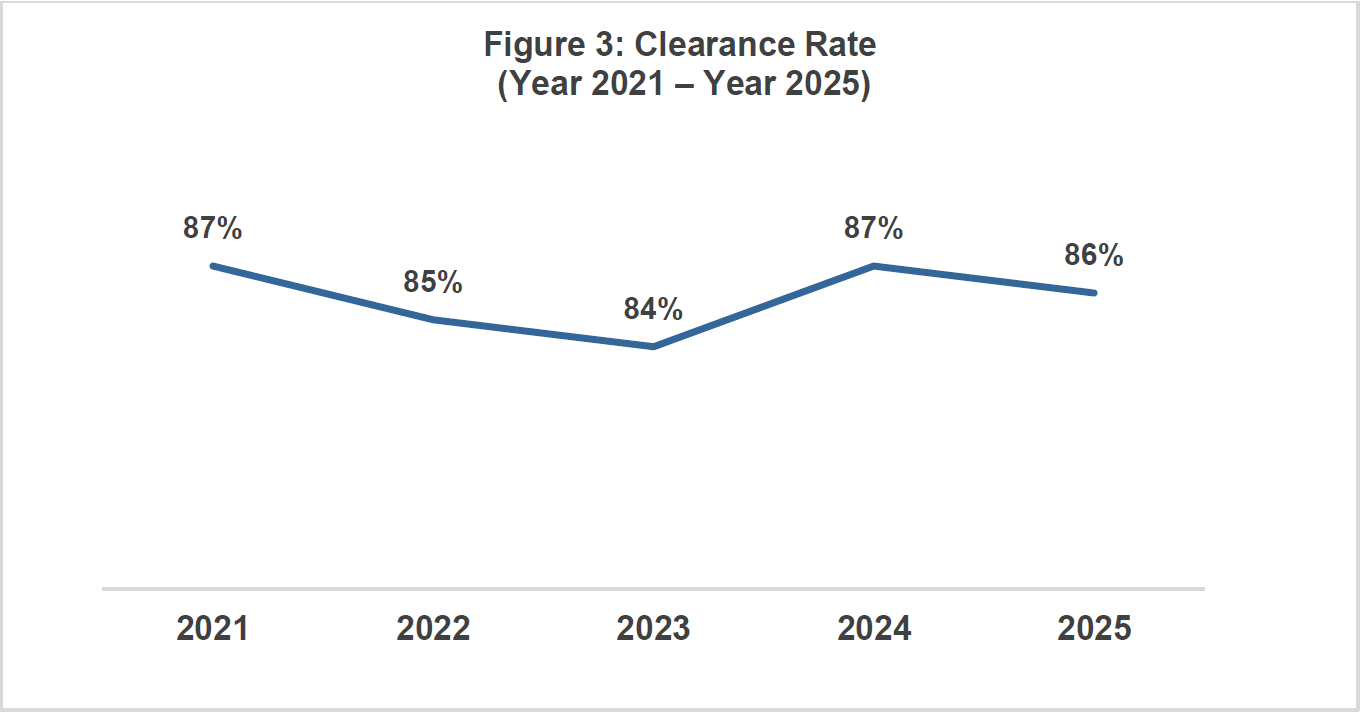
5. In 2025, CPIB achieved a clearance rate3 of 86% (Figure 3).
High Conviction Rate
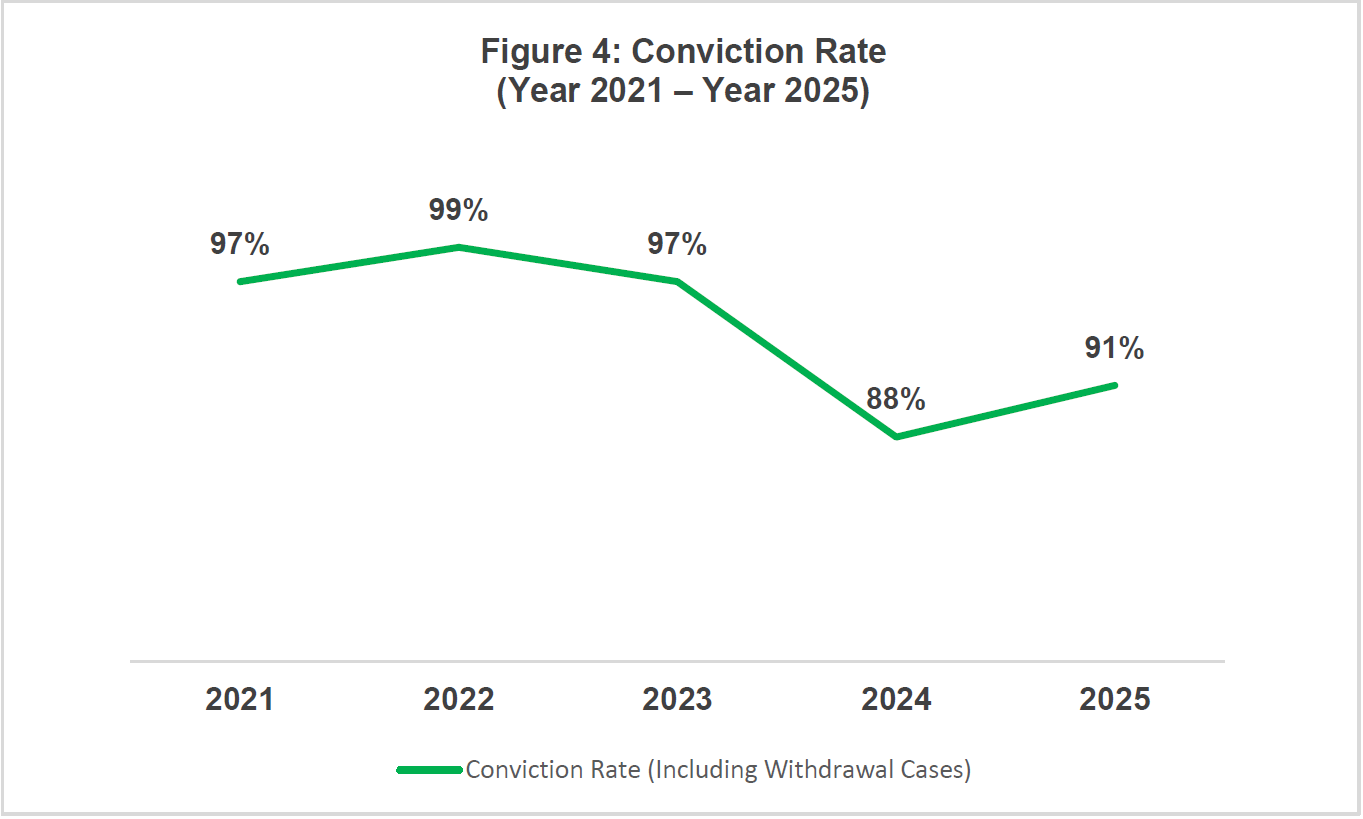
6. The conviction rate for CPIB cases in 2025 was 100% (excluding withdrawal cases). The conviction rate stood at 91% if withdrawal cases were included (Figure 4). Withdrawals refer to cases withdrawn after the accused was charged in Court and before any Court decision was made.
7. CPIB will henceforth only report the conviction rate that includes withdrawal cases. This statistic offers a more accurate representation of CPIB’s success in securing conviction.
Strong International Standing
8. Singapore continues to be well-regarded internationally for our anti-corruption approach and efforts. The latest 2025 Transparency International’s Corruption Perceptions Index (TI-CPI) ranked Singapore as the third least corrupt country out of 182 countries, with a score of 84 out of 100, the same rank and score as the preceding year4. Singapore remained the top ranked country in the Asia-Pacific region. In the 2025 Report on Corruption by the Political and Economic Risk Consultancy, Singapore received the best score among 16 economies in Asia, the US and Australia. In the World Justice Project Rule of Law Index 2025, Singapore improved our ranking from third to second out of 143 countries for absence of corruption in government.
Improvement in Public Perception of Corruption Control Efforts
9. Annually, CPIB commissions the Public Perception Survey5 to gauge the perceived level of corruption in Singapore, public understanding of corruption, and perception of the Bureau’s effectiveness in curbing corruption.
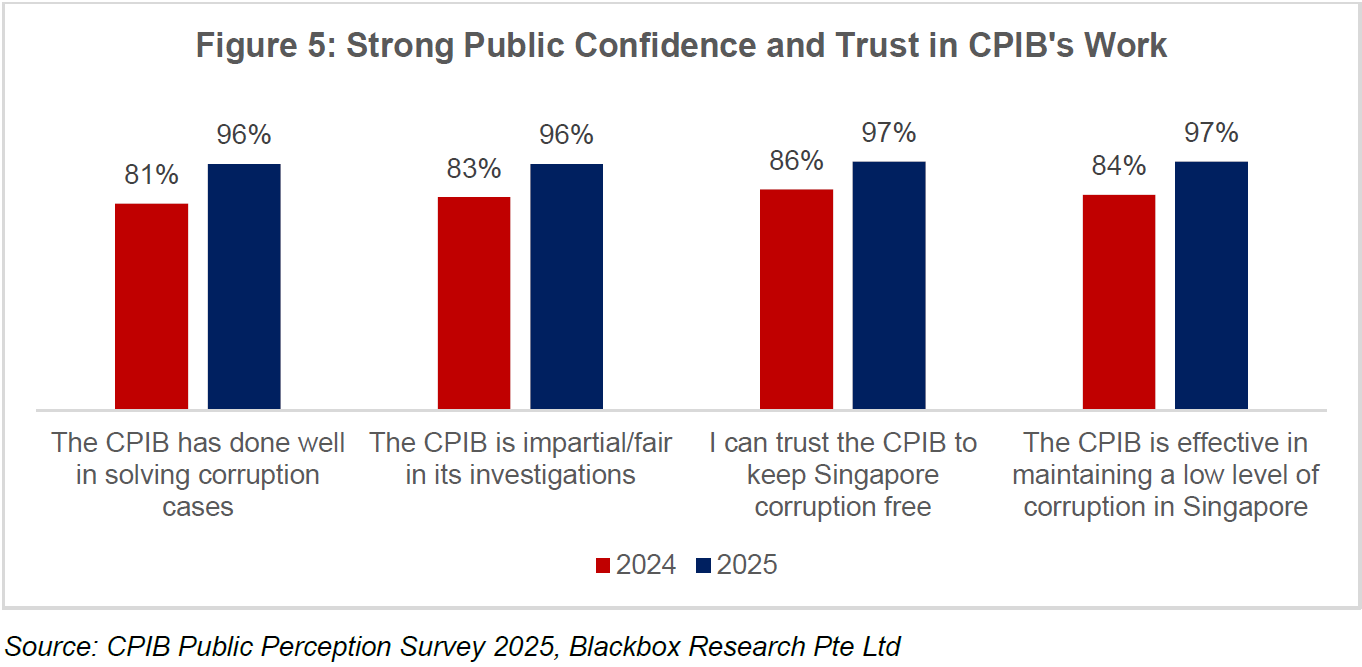
10. In the 2025 survey, 98% of respondents rated the corruption situation in Singapore as Good, Very Good, or Excellent. Political will to keep corruption under control, a zero-tolerance culture for corruption, and effective anti-corruption laws were cited as the top three factors contributing to the low corruption rate in Singapore. There was significant improvement in the public confidence and trust in CPIB compared with 2024. Over 95% of the respondents gave favourable responses (Strong Agree or Agree) to related questions in the survey (Figure 5).
Effective Enforcement Against Corruption
11. Swift and decisive enforcement action taken by CPIB underscores Singapore’s zero-tolerance approach towards corruption and ensures a level-playing field for businesses operating in Singapore and the wider community.
Case 1 – Investigation Against Five Foreigners in Scheme to Deliberately Commit Corruption and Get Arrested to Illegally Sell Sex Enhancement Medications
On 18 July 2025, five Chinese nationals were charged in Court for allegedly offering bribes to enforcement officers from the National Environment Agency and the Singapore Police Force to avoid enforcement action for various offences, including smoking in prohibited areas and involvement in a traffic accident. All bribes were rejected by the enforcement officers.
CPIB investigation uncovered a scheme whereby these five foreigners allegedly planned to get arrested so as to obtain Special Passes and prolong their stay in Singapore with the intent to illegally sell Sex Enhancement Medications while out on bail. Further investigation revealed that these foreigners allegedly paid their bailors to facilitate their bail and bail extensions. All five foreigners were remanded without bail and investigations with respect to the scheme are ongoing.
Case 2 – Investigation Against Nine Individuals Arrested for Fixing Basketball Matches
On 19 August 2025, nine individuals were arrested by CPIB for alleged involvement in fixing basketball matches in the 2025 K. Star National Basketball League Division 1.
These individuals, comprising eight Singaporeans and one permanent resident aged between 19 and 35 years old, included players from the basketball teams taking part in the competition. CPIB investigation revealed that one of the alleged fixed basketball matches took place on 1 August 2025. Investigations against the arrested persons for alleged corruption are ongoing.
Case 3 – Investigation Against a Former Esplanade and Arts House Employee, Three Directors and Their Companies
On 31 October 2025, a former employee of The Esplanade Co Ltd (“TECL”) and the Arts House Limited (“AHL”), Saburulla S/O Abdul Gani (“Saburulla”), was charged with alleged corruption, along with three directors and their companies.
Saburulla allegedly obtained over S$96,000 in bribes between 2005 and 2022 from three company directors of two different firms – a Director of JYD Design Pte Ltd, Yeoh Wee Yeong, and two Directors of Aceproject Construction Pte Ltd, Chew Kim Kee and Eng Kim Hai – in exchange for advancing their business interests with TECL or AHL in various renovation and installation projects.
The individuals also allegedly conspired to submit false quotations with no genuine intention of bidding, making the two companies appear to offer the lowest prices and securing them multiple contracts with TECL or AHL. The case is currently before the Court.
Case 4 – Investigation Against a Former Driving Tester for Attempting to Obtain Bribe from Test Candidate
On 11 December 2025, Muhamad Zahirey Bin Ishak (“Zahirey”), a driving tester with People Advantage Pte Ltd deployed to Bukit Batok Driving Centre (“BBDC”) at the material time of the offence, was charged for an offence under the Prevention of Corruption Act.
Zahirey allegedly attempted to obtain S$150 from a driving test candidate at BBDC, as a reward for showing leniency during the candidate’s practical driving test so that the candidate could qualify for a Singapore Driving Licence. The case is currently before the Court.
Collective Action Key to Corruption Prevention
12. Together with a vigilant public, a collective approach to corruption prevention complements enforcement efforts by reinforcing integrity and incorruptibility within society, ensuring that corruption has little opportunity to take root.
13. Over the past year, CPIB has intensified our corruption prevention efforts across both the public and private sectors and also invested more efforts on the vulnerable industries by partnering relevant stakeholders, including the media, professional bodies and trade associations to amplify anti-corruption messages.
14. CPIB partners with public sector agencies to identify touchpoints and co-develop targeted resources that address their specific operational context and challenges. Our work with Certis illustrates this collaborative approach where we jointly developed a customised anti-corruption training module for their Auxiliary Police Officers.
15. CPIB continues to engage and bolster corruption prevention efforts in the private sector via the Anti-Corruption Partnership Network (ACPN). On 5 September 2025, over 160 professionals from financial institutions, auditing and consultancy firms, professional bodies, and industry associations attended the annual ACPN event co-organised by CPIB and the Institute of Singapore Chartered Accountants (ISCA). Participants shared and exchanged best practices on how technology, professional ethics, and collaboration can strengthen anti-corruption efforts.
Conclusion
16. Singapore's corruption situation remains firmly under control. CPIB will continue to take effective enforcement against corrupt offenders, and deepen partnerships with stakeholders and the community to keep our home free from corruption.
[1] Public sector employees who rejected bribes comprised officers from
the Immigration & Checkpoints Authority (ICA), the Land Transport Authority,
the National Environment Agency (NEA), the Singapore Police Force (SPF),
and an officer from the Certis Cisco Aviation Security Pte Ltd who was
performing a public function.
[2] The six public sector employees prosecuted were from the National
Environment Agency, the Singapore Armed Forces, the Singapore Civil Defence
Force, the Singapore Prison Service, St. Anthony’s Canossian Secondary
School, and St. Joseph’s Institution.
[3] Clearance rate refers to the total number of subjects CPIB has completed
investigation on, out of the total number of subjects investigated by CPIB
in the year.
[4] The TI-CPI ranks and measures countries by their perceived levels
of public sector corruption. The 2025 index draws upon 13 expert assessments
and business surveys. Countries are then scored on a scale of zero, for
highly corrupt, to 100, for very clean.
[5] CPIB engages an independent research company to gauge public perception
on corruption and the Bureau. The survey, carried out annually since 2024,
is conducted with 1,000 individuals representative of the Singapore population
profile.
Corrupt Practices Investigation Bureau